
Development of multiliteracy assessment with the STEAM approach to enhance 4C skills in geometry learning
##plugins.themes.bootstrap3.article.sidebar##
##plugins.themes.bootstrap3.article.main##
Abstract
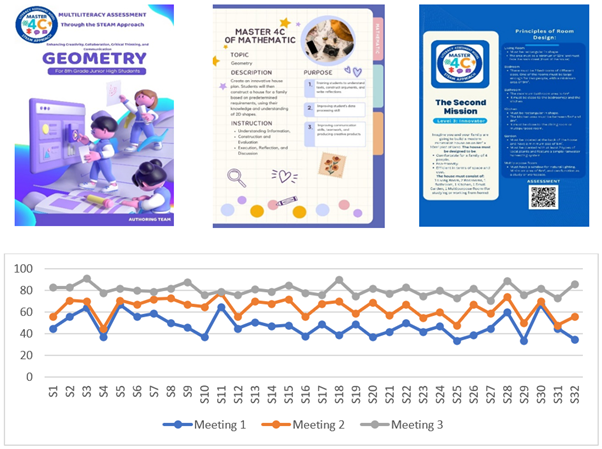
The 4C skills (communication, collaboration, creativity, critical thinking) represent essential competencies for 21st-century students. Multiliteracy contexts play a crucial role in supporting learning, while assessment contributes significantly to achieving educational objectives. However, Indonesian students' PISA results remain very low, particularly in understanding assessments within multiliteracy contexts. Multiliteracy assessment utilizing a STEAM approach offers a solution for developing students' 4C skills in geometry learning through project-based activities. Therefore, this study aims to create an innovative multiliteracy assessment, MASTER-4C, to enhance the development of 4C skills. This research employs an R&D methodology based on the ADDIE model. Participants included six expert validators, two teachers, and 32 eighth-grade students. Results demonstrate that MASTER-4C is a valid multiliteracy learning assessment. Student and teacher responses reached 91.5% and 87%, respectively, categorizing it as highly practical. The activity-based N-Gain scores for communication, collaboration, creativity, and critical thinking skills were 0.62, 0.62, 0.63, and 0.45, respectively. These scores were classified as moderate improvement, with MASTER-4C achieving an 87.5% success rate in the implementation of geometry learning. These findings suggest that MASTER-4C is a functional and valid multiliteracy assessment that effectively supports students' 4C skill development. MASTER-4C shows promise in geometry learning, though broader applicability needs further study.
##plugins.themes.bootstrap3.article.details##

This work is licensed under a Creative Commons Attribution-ShareAlike 4.0 International License.
The author is responsible for acquiring the permission(s) to reproduce any copyrighted figures, tables, data, or text that are being used in the submitted paper. Authors should note that text quotations of more than 250 words from a published or copyrighted work will require grant of permission from the original publisher to reprint. The written permission letter(s) must be submitted together with the manuscript.References
Álvarez-Huerta, P., Muela, A., & Larrea, I. (2022). Disposition toward critical thinking and creative confidence beliefs in higher education students: The mediating role of openness to diversity and challenge. Thinking Skills and Creativity, 43, 101003. https://doi.org/10.1016/j.tsc.2022.101003
Amgott, N. (2023). “The challenge was fun”: Critical literacy and growth mindset in L2 multiliteracies. System, 113, 103000. https://doi.org/10.1016/j.system.2023.103000
Andersen, R., & Rustad, M. (2022). Using Minecraft as an educational tool for supporting collaboration as a 21st century skill. Computers and Education Open, 3, 100094. https://doi.org/10.1016/j.caeo.2022.100094
Asman, A., Kumaro, M., & Barliana, M. S. (2022). Integration of 4Cs skills into learning by using the project based learning (PjBL) model to face the challenges of the 21st century. In (pp. 88–93). https://doi.org/10.2991/assehr.k.220305.018
Barta, A., Fodor, L. A., Tamas, B., & Szamoskozi, I. (2022). The development of students critical thinking abilities and dispositions through the concept mapping learning method – A meta-analysis. Educational Research Review, 37, 100481. https://doi.org/10.1016/j.edurev.2022.100481
Beltrán-Palanques, V. (2024). Assessing video game narratives: Implications for the assessment of multimodal literacy in ESP. Assessing Writing, 60, 100809. https://doi.org/10.1016/j.asw.2024.100809
Bray, A., Girvan, C., & Chorcora, E. N. (2023). Students’ perceptions of pedagogy for 21st century learning instrument (S-POP-21): Concept, validation, and initial results. Thinking Skills and Creativity, 49, 101319. https://doi.org/10.1016/j.tsc.2023.101319
Castellano-Sanz, M., & Reyes-Torres, A. (2024). Multiliteracies in minority language contexts: A multimodal learning path to promote learners' meaning-making process and aesthetic experiences. L1-Educational Studies in Language and Literature, 24(3), 1–29. https://doi.org/10.21248/l1esll.2024.24.3.602
Chappell, K., Hetherington, L., Juillard, S., Aguirre, C., & Duca, E. (2025). A framework for effective STEAM education: Pedagogy for responding to wicked problems. International Journal of Educational Research Open, 9, 100474. https://doi.org/10.1016/j.ijedro.2025.100474
El Bedewy, S., Lavicza, Z., Sabitzer, B., Houghton, T., & Nurhasanah, F. (2024). Exploring transdisciplinary, technology-assisted, and architectural modelling STEAM practices through a cultural lens. European Journal of Science and Mathematics Education, 12(2), 211–235. https://doi.org/10.30935/scimath/14304
Falloon, G. (2024). Investigating pedagogical, technological and school factors underpinning effective ‘critical thinking curricula’ in K-6 education. Thinking Skills and Creativity, 51, 101447. https://doi.org/10.1016/j.tsc.2023.101447
Henríquez-Rivas, C., & Vergara-Gómez, A. (2025). Design and validation of a questionnaire to explore the geometric work of mathematics teachers. European Journal of Science and Mathematics Education, 13(2), 103–118. https://doi.org/10.30935/scimath/16161
Herlinawati, H., Marwa, M., Ismail, N., Junaidi, J., Liza, L. O., & Situmorang, D. D. B. (2024). The integration of 21st century skills in the curriculum of education. Heliyon, 10(15), e35148. https://doi.org/10.1016/j.heliyon.2024.e35148
Hidayanthi, R., Siregar, N. H., Siregar, D. A., & Siregar, H. L. (2024). Implementation of STEAM-based digital learning for students' numeracy literacy in elementary schools. Research and Development in Education (RaDEn), 4(1), 653–661. https://doi.org/10.22219/raden.v4i1.32663
Hsu, T.-C., Chang, Y.-S., Chen, M.-S., Tsai, I. F., & Yu, C.-Y. (2023). A validity and reliability study of the formative model for the indicators of STEAM education creations. Education and Information Technologies, 28(7), 8855–8878. https://doi.org/10.1007/s10639-022-11412-x
Humble, S., Dixon, P., & Mpofu, E. (2018). Factor structure of the torrance tests of creative thinking figural form a in Kiswahili speaking children: Multidimensionality and influences on creative behavior. Thinking Skills and Creativity, 27, 33–44. https://doi.org/10.1016/j.tsc.2017.11.005
Irdalisa, I., Paidi, P., Panigrahi, R. R., & Hanum, E. (2024). Project-based learning on STEAM-based student's worksheet with ecoprint technique: effects on student scientific reasoning and creativity. Jurnal Inovasi Pendidikan IPA, 10(2), 222–236. https://doi.org/10.21831/jipi.v10i2.77676
Jaakma, K., & Kiviluoma, P. (2019). Auto-assessment tools for mechanical computer aided design education. Heliyon, 5(10), e02622. https://doi.org/10.1016/j.heliyon.2019.e02622
Januarty, W., Utami, E. Y., Basir, B., & Telaumbanua, E. (2024). Quantitative analysis of the effect of research and development (R&D) networks on innovation and competitive advantage in Indonesia case studies in the manufacturing industry. Sciences du Nord Economics and Business, 1(1), 33–39.
Kain, C., Koschmieder, C., Matischek-Jauk, M., & Bergner, S. (2024). Mapping the landscape: A scoping review of 21st century skills literature in secondary education. Teaching and Teacher Education, 151, 104739. https://doi.org/10.1016/j.tate.2024.104739
Karkar Esperat, T. M., & Stickley, Z. L. (2024). Revisioning curriculum through the transmulitliteracies sustaining pedagogy approach. Social Sciences & Humanities Open, 9, 100826. https://doi.org/10.1016/j.ssaho.2024.100826
Krumm, G., Arán Filipppetti, V., Lemos, V., Koval, J., & Balabanian, C. (2016). Construct validity and factorial invariance across sex of the torrance test of creative thinking – Figural form a in Spanish-speaking children. Thinking Skills and Creativity, 22, 180–189. https://doi.org/10.1016/j.tsc.2016.10.003
Kurniawan, T. T. (2021). Development of 4c-based hots assessment to improve critical thinking skills in grade 6 students of Kudus elementary school. JURNAL PAJAR (Pendidikan dan Pengajaran), 5(3), 675–683. https://doi.org/10.33578/pjr.v5i3.8319
Li, Z., Zhou, M., & Lam, K. K. L. (2022). Dance in Zoom: Using video conferencing tools to develop students' 4C skills and self-efficacy during COVID-19. Thinking Skills and Creativity, 46, 101102. https://doi.org/10.1016/j.tsc.2022.101102
Lim, F. V., Toh, W., & Ong, M. (2024). Assessing multiliteracies: a systematic review and a perspective from Singapore. Asia Pacific Journal of Education, 44(3), 597–610. https://doi.org/10.1080/02188791.2024.2390658
Lüdke, T., Polk, M.-L., Günther, S., Kluge, A., Zahnert, T., & Neudert, M. (2023). Digital teaching and assessment of psychomotor skills of the clinical head and neck examination during COVID-19 pandemic. European Archives of Oto-Rhino-Laryngology, 280(11), 4835–4844. https://doi.org/10.1007/s00405-023-07998-8
Maulina, J., Dewi, S. V., Zuhri, Z., Zakiah, N., Happy, N., & Rafiqoh, S. (2024). Integrating STEAM in project-based learning to foster soft skills in higher education. Mimbar Ilmu, 29(3), 460–466. https://doi.org/10.23887/mi.v29i3.90372
Muhammad, I., Jupri, A., & Herman, T. (2025). Development of web-based learning media with a realistic mathematics education approach to increase student self-determination. Infinity Journal, 14(2), 303–322. https://doi.org/10.22460/infinity.v14i2.p303-322
Normore, G. P. M., Leibovitch, Y. M., Brown, D. J., Pearson, S., Mazzola, C., Ellerton, P. J., & Watt, G. (2024). Investigating the impact of critical thinking instruction on writing performance: A multilevel modelling analysis of relative gain data in the Australian national assessment program. Thinking Skills and Creativity, 53, 101546. https://doi.org/10.1016/j.tsc.2024.101546
Nurdalilah, N., & Harahap, A. N. (2024). Development of learner worksheet (LKPD) using RME approach based on Mandailing culture to improve student literacy. AKSIOMA: Jurnal Program Studi Pendidikan Matematika, 13(2), 684–698. https://doi.org/10.24127/ajpm.v13i2.8754
Pramasdyahsari, A. S., Rubowo, M. R., Nindita, V., Astutik, I. D., Pant, B. P., Dahal, N., & Luitel, B. C. (2025). Developing engaging STEAM-geometry activities: Fostering mathematical creativity through the engineering design process using Indonesian cuisine context. Infinity Journal, 14(1), 213–234. https://doi.org/10.22460/infinity.v14i1.p213-234
Rapti, S., Sapounidis, T., & Tselegkaridis, S. (2025). Review of robotics activities to promote kindergarteners’ communication, collaboration, critical thinking, and creativity. Information, 16(4), 260. https://doi.org/10.3390/info16040260
Rudianto, R., Diani, R., Subandi, S., & Widiawati, N. (2022). Development of assessment instruments 4C skills (critical thinking, collaboration, communication, and creativity) on parabolic motion materials. Journal of Advanced Sciences and Mathematics Education, 2(2), 65–79. https://doi.org/10.58524/jasme.v2i2.115
Setiyani, S., Gunawan, G., Waluya, S. B., Sukestiyarno, Y. L., Cahyono, A. N., Mutia, M., & Yunianto, W. (2025). The role of scaffolding in shaping reflective mathematical thinking of dependent field students in numeracy problems. Infinity Journal, 14(2), 531–550. https://doi.org/10.22460/infinity.v14i2.p531-550
Setiyani, S., Waluya, S. B., Sukestiyarno, Y. L., Cahyono, A. N., & Santi, D. P. D. (2024). Assessing numeracy skills on flat shapes and scaffolding forms in junior high school. International Journal of Evaluation and Research in Education (IJERE), 13(1), 422–432. https://doi.org/10.11591/ijere.v13i1.25186
Sk, S., & Halder, S. (2020). Critical thinking disposition of undergraduate students in relation to emotional intelligence: Gender as a moderator. Heliyon, 6(11), e05477. https://doi.org/10.1016/j.heliyon.2020.e05477
Summak, M. S., Samancioğlu, M., & Bağlibel, M. (2010). Technology integration and assesment in educational settings. Procedia - Social and Behavioral Sciences, 2(2), 1725–1729. https://doi.org/10.1016/j.sbspro.2010.03.973
Supianti, I. I., Yaniawati, P., Bonyah, E., Hasbiah, A. W., & Rozalini, N. (2025). STEAM approach in project-based learning to develop mathematical literacy and students' character. Infinity Journal, 14(2), 283–302. https://doi.org/10.22460/infinity.v14i2.p283-302
Syukri, M., Ukhaira, Z., Zainuddin, Z., Herliana, F., & Arsad, N. M. (2022). The influence of STEAM-based learning application on students' critical thinking ability. Asian Journal of Science Education, 4(2), 37–45. https://doi.org/10.24815/ajse.v4i2.28272
Thornhill-Miller, B., Camarda, A., Mercier, M., Burkhardt, J.-M., Morisseau, T., Bourgeois-Bougrine, S., Vinchon, F., El Hayek, S., Augereau-Landais, M., Mourey, F., Feybesse, C., Sundquist, D., & Lubart, T. (2023). Creativity, critical thinking, communication, and collaboration: Assessment, certification, and promotion of 21st century skills for the future of work and education. Journal of Intelligence, 11(3), 54. https://doi.org/10.3390/jintelligence11030054
Trina, N. A., Monsur, M., Cosco, N., Shine, S., Loon, L., & Mastergeorge, A. (2025). Tools for assessing the STEAM learning affordances and quality of outdoor learning environments of childcare centers: A systematic review. Early Childhood Education Journal. https://doi.org/10.1007/s10643-025-01911-0
Usanova, I., Schnoor, B., Bar-Kochva, I., & Schröter, H. (2024). Multiliteracy as human capital in first-generation adult immigrants in Germany. International Journal of Bilingual Education and Bilingualism, 27(10), 1422–1436. https://doi.org/10.1080/13670050.2024.2375445
Utomo, E. S., Juniati, D., & Siswono, T. Y. E. (2018). Exploring aspects of mathematical visualization of junior high school student in a problem-solving task. Malaysian Journal of Mathematical Sciences, 12(3), 421–436.
Wang, Y. (2024). An interactive online educational environment to reduce anxiety, improve emotional well-being, and critical thinking for college students. Acta Psychologica, 248, 104347. https://doi.org/10.1016/j.actpsy.2024.104347
Yim, I. H. Y., Su, J., & Wegerif, R. (2024). STEAM in practice and research in primary schools: a systematic literature review. Research in Science & Technological Education, 43(4), 1065–1089. https://doi.org/10.1080/02635143.2024.2440424
Yin, X., Saad, M. R. B. M., & Halim, H. B. A. (2023). A systematic review of critical thinking instructional pedagogies in EFL writing: What do we know from a decade of research. Thinking Skills and Creativity, 49, 101363. https://doi.org/10.1016/j.tsc.2023.101363
Yulianti, E., Suwono, H., Abd Rahman, N. F., & Phang, F. A. (2024). State-of-the-art of STEAM education in science classrooms: A systematic literature review. Open Education Studies, 6(1), 20240032. https://doi.org/10.1515/edu-2024-0032
Zhao, Y., Liu, Y., & Wu, H. (2024). Relationships among critical thinking disposition components of Chinese undergraduates: A moderated mediating effect analysis. International Journal of Educational Research, 124, 102306. https://doi.org/10.1016/j.ijer.2023.102306